

You’re a seasoned software engineer, a decade or more deep in the trenches, shipping code, solving complex problems, and navigating the ever-shifting sands of technology. You’ve built systems from the ground up, refactored monoliths, danced with micro-services, and probably have a graveyard of forgotten frameworks in your mental attic.
But despite the countless lines of code written and systems launched, there’s a subtle yet profound distinction that often gets blurred, even by the most experienced among us: the line between Architecture and Design.
This isn’t just semantics. Understanding this divide – truly understanding it – isn’t about passing a certification. It’s about fundamentally altering how you approach problem-solving, how you build resilient systems, and ultimately, how you sculpt software that stands the test of time, scales under pressure, and evolves with grace. This article isn’t just going to define the terms; it’s going to explore why this distinction holds the key to your next decade of engineering excellence.
The Elephant in the Room: Why Do We Confuse Them?
Let’s be honest, the terms “architect” and “designer” are often used interchangeably in job titles and daily conversations. We talk about “designing an architecture” or “architecting a component.” This linguistic fuzziness reflects a deeper systemic issue: a lack of explicit differentiation in many organizations.
Part of the confusion stems from the historical evolution of our craft. In the early days, a single engineer often handled everything from the foundational structure to the minutiae of a class’s methods. As systems grew in complexity, specializations emerged. Yet, the mental model often lagged, leading to architects dabbling in low-level design and senior designers making architectural choices without a holistic view.
Architectures that are beautiful on paper but impossible to implement.
Designs that are elegant at a component level but create integration nightmares.
Systems that scale horizontally but are brittle internally.
Teams constantly refactoring the wrong things because the foundational principles were never clearly established.
Architecture: The Blueprint of Existence
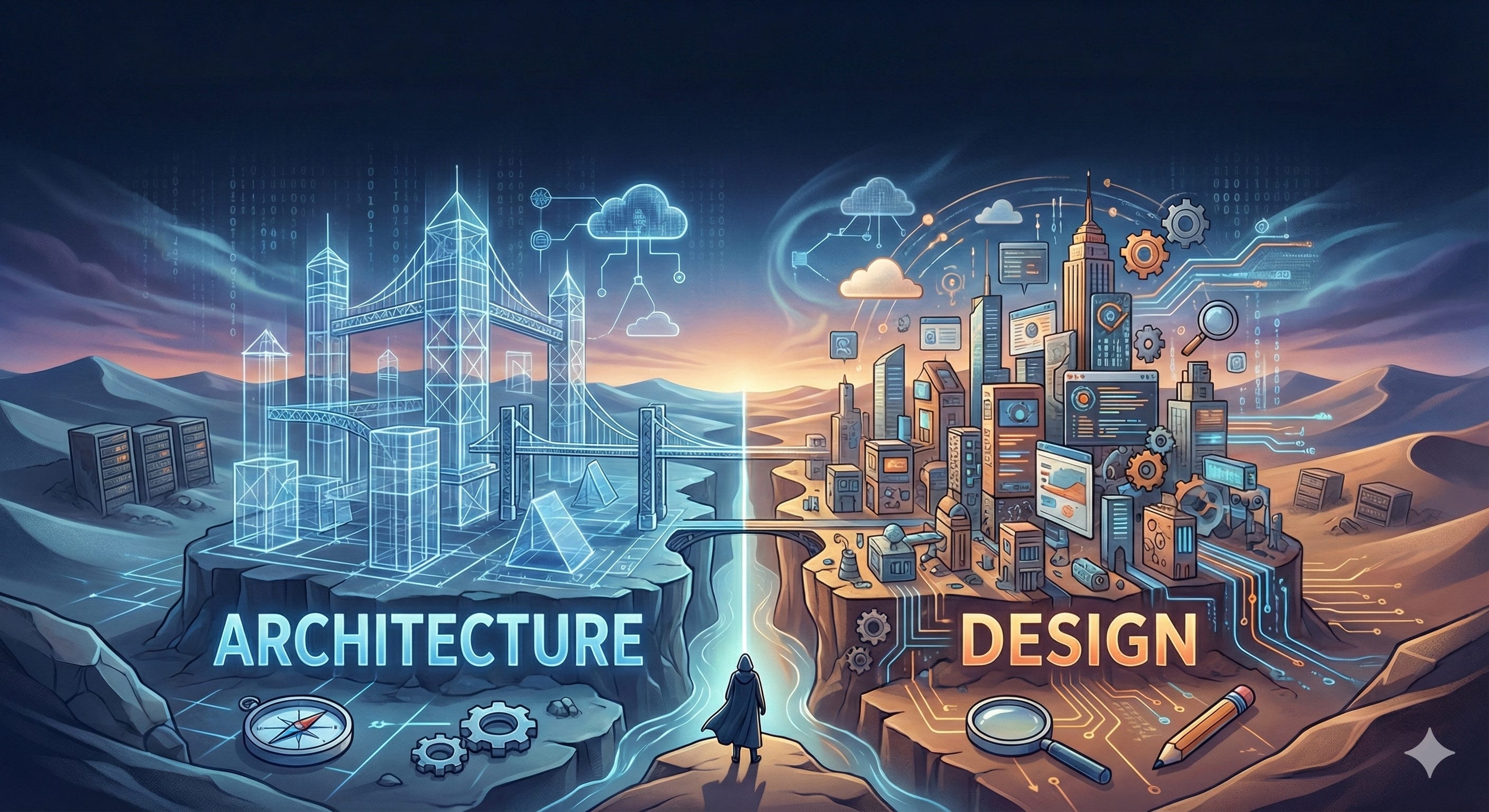
Think of software architecture like the blueprint of a city or a large building. It defines the fundamental structure, the main components, their relationships, and the principles governing their interaction.
Key Characteristics of Architecture:
High-Level, Strategic Decisions: Architecture deals with the “what” and “why” at a macro level. It answers questions like:
What are the primary systems involved (e.g., microservices, monolith, serverless)?
How will they communicate (e.g., REST, gRPC, Kafka, message queues)?
What are the core technologies and frameworks (e.g., Kubernetes, .NET Core, Node.js)?
How will data be stored and accessed across the system (e.g., SQL, NoSQL, data lakes)?
What are the non-functional requirements (NFRs) that must be met (scalability, security, performance, fault tolerance, maintainability)?
How will deployment, monitoring, and logging be handled across the entire ecosystem?
Concerned with Cross-Cutting Concerns: Architectural decisions inherently impact multiple parts of the system. Security protocols, logging standards, error handling mechanisms, transaction management – these are architectural concerns that must be consistent across the board.
Shapes Constraints and Boundaries: Architecture defines the sandbox within which design can happen. It sets the rules, dictates the available tools, and outlines the integration points. For instance, if the architecture mandates an event-driven microservices approach, individual services must conform to that paradigm.
Long-Term Vision and Stability: Architectural decisions are notoriously difficult and expensive to change once implemented. They represent a significant investment and commitment. A good architecture anticipates future needs and provides a robust, adaptable foundation, minimizing the need for complete overhauls.
Focus on “ilities”: Scalability, reliability, maintainability, testability, security, usability, deployability – these “ilities” are the bread and butter of architecture. They are the quality attributes that ensure the system remains viable and effective over its lifespan.
Analogy: If your software is a house, the architecture defines whether it’s a skyscraper, a bungalow, or a tent. It determines the foundation, the number of floors, the main structural beams, the plumbing and electrical systems, and how these major systems interact. It ensures the building can withstand earthquakes (fault tolerance) and accommodate future expansions (scalability).
Design: The Art of Implementation and Detail
If architecture is the city plan, then design is the detailed blueprint of a specific building, a floor plan, or even an individual room. It’s about bringing the architectural vision to life, detailing how a specific component or system will fulfill its architectural mandate.
Key Characteristics of Design:
Detailed, Component-Level Decisions: Design deals with the “how” at a granular level. It answers questions like:
How will this specific microservice be structured internally (e.g., layered architecture, hexagonal architecture)?
What classes, interfaces, and modules will it contain?
How will data flow within this component?
What specific algorithms will be used to implement a feature?
How will error handling be implemented within this service?
What design patterns (e.g., Factory, Singleton, Observer) will be applied at a class or module level?
What are the specific API contracts for a service or a module?
Focus on Specific Functionality: Design is concerned with the implementation of particular features, functionalities, or services as defined by the architecture.
Within Architectural Constraints: Design decisions are made within the boundaries and guidelines established by the architecture. A designer cannot suddenly decide to use a different database for their microservice if the architecture dictates a specific data storage strategy.
More Iterative and Adaptable: While good design is also crucial, its scope is more localized. Changes to specific design elements are generally less impactful and less costly than changing fundamental architectural decisions. Design evolves as features are built and refined.
Concerned with Code Quality and Developer Experience: Good design leads to clean, maintainable, readable, and testable code. It directly impacts the day-to-day life of engineers working on the codebase. Principles like SOLID, DRY, YAGNI are paramount here.
Analogy: Continuing with the house analogy, design defines the layout of each room, where the walls go, the specific type of windows, the material of the floors, the placement of electrical outlets, and how the furniture will be arranged. It ensures each room is functional, aesthetically pleasing, and serves its purpose within the overall house structure.
Architecture and Design are not isolated silos. They are two sides of the same coin, deeply intertwined and mutually dependent.
Architecture Informs Design: Architecture provides the overarching framework, the guiding principles, and the constraints that inform all subsequent design decisions. A robust architecture makes design simpler and more consistent.
Design Validates Architecture: Detailed design and implementation can expose flaws or impracticalities in the architectural vision. Sometimes, what looks good on an architectural diagram proves challenging or inefficient to implement in practice, necessitating a feedback loop to the architectural layer.
Poor Design Can Undermine Architecture: Even the most brilliant architecture can crumble under the weight of poor design. Inefficient algorithms, tightly coupled components, or a lack of attention to detail at the design level can negate all the benefits of a well-thought-out architecture.
Tactical vs. Strategic: Architecture is inherently strategic; it looks years ahead. Design is more tactical, focused on delivering features within the current sprint or release cycle, but always within that strategic architectural context.
For us, the seasoned engineers, understanding this distinction is more than academic. It’s about elevating our craft and maximizing our impact:
Speak the Right Language: When discussing problems, be precise. Is it an architectural problem (e.g., “our system can’t handle the load at scale”), or a design problem (e.g., “this service’s internal module coupling is too high”)? This clarity streamlines communication and problem-solving.
Contribute at the Right Level: As senior engineers, you’re expected to contribute to both. When engaged in architectural discussions, focus on the big picture, the NFRs, and the long-term viability. When diving into a component, focus on elegance, maintainability, and efficiency.
Bridge the Gap: Often, architects create the vision, and individual teams execute the design. You, with your experience, are perfectly positioned to be the bridge. You can translate architectural mandates into actionable design principles for your team and provide valuable feedback from the trenches back to the architects.
Mentor the Next Generation: Teach junior engineers this distinction early. It instills a holistic view of software development that prevents them from getting lost in the weeds or making premature architectural decisions at the wrong level.
Architect for Evolvable Design: A truly great architecture doesn’t just work; it enables great design. It offers clear interfaces, defined boundaries, and a robust framework that allows designers to build flexible, high-quality components without constantly fighting the system.
Building for Tomorrow, Today
In our rapidly evolving industry, the allure of the next shiny framework can often overshadow the fundamental principles of software construction. But for those of us committed to building lasting, impactful software, the distinction between architecture and design is paramount.
Architecture lays the resilient foundation, defines the grand vision, and safeguards the strategic future of your system. Design then meticulously crafts the internal mechanisms, ensuring efficiency, maintainability, and immediate functionality.
When you understand these small but important differences, you become a better leader and decision-maker. You stop just “writing code” and start building complete environments. Instead of making something that only works right now, you create systems that are ready to grow and handle whatever happens in the future.
What are your experiences with this distinction? Have you seen its impact – positive or negative – in the systems you’ve built? Share your thoughts below!